Sysbot Technologies

Research & Innovation

Research you can check.

Emerging web technologies, AI-era website architecture, technical prototypes and experimental AI experiences. Every sourced claim is graded and re-checked; every prototype has a pre-registered gate and a measured result.

Research publication

Websites for the AI Era

A website in the AI era is a business interface served from one content store to several kinds of client: people who arrive already informed by an answer engine, search engines, AI assistants and software agents acting on a person’s behalf. The study maps five shifts that are measurable today, grades every sourced claim, and turns the findings into a reference architecture and a prototype roadmap.

Research study · v1.1Published 30 October 2026 · revised 31 October 2026

Websites for the AI Era: How Discovery, Agents and Generative Interfaces Are Reshaping the Web

A research study from Sysbot Technologies on how AI discovery, agents as visitors, catalog-constrained generative interfaces, prompt-built sites and new trust rules are reshaping what a website is. Version 1.1, 31 October 2026, with a companion evidence register.

Author
Logesh Chandran
Reading time
about 70 minutes
Formats
Web, PDF, Markdown
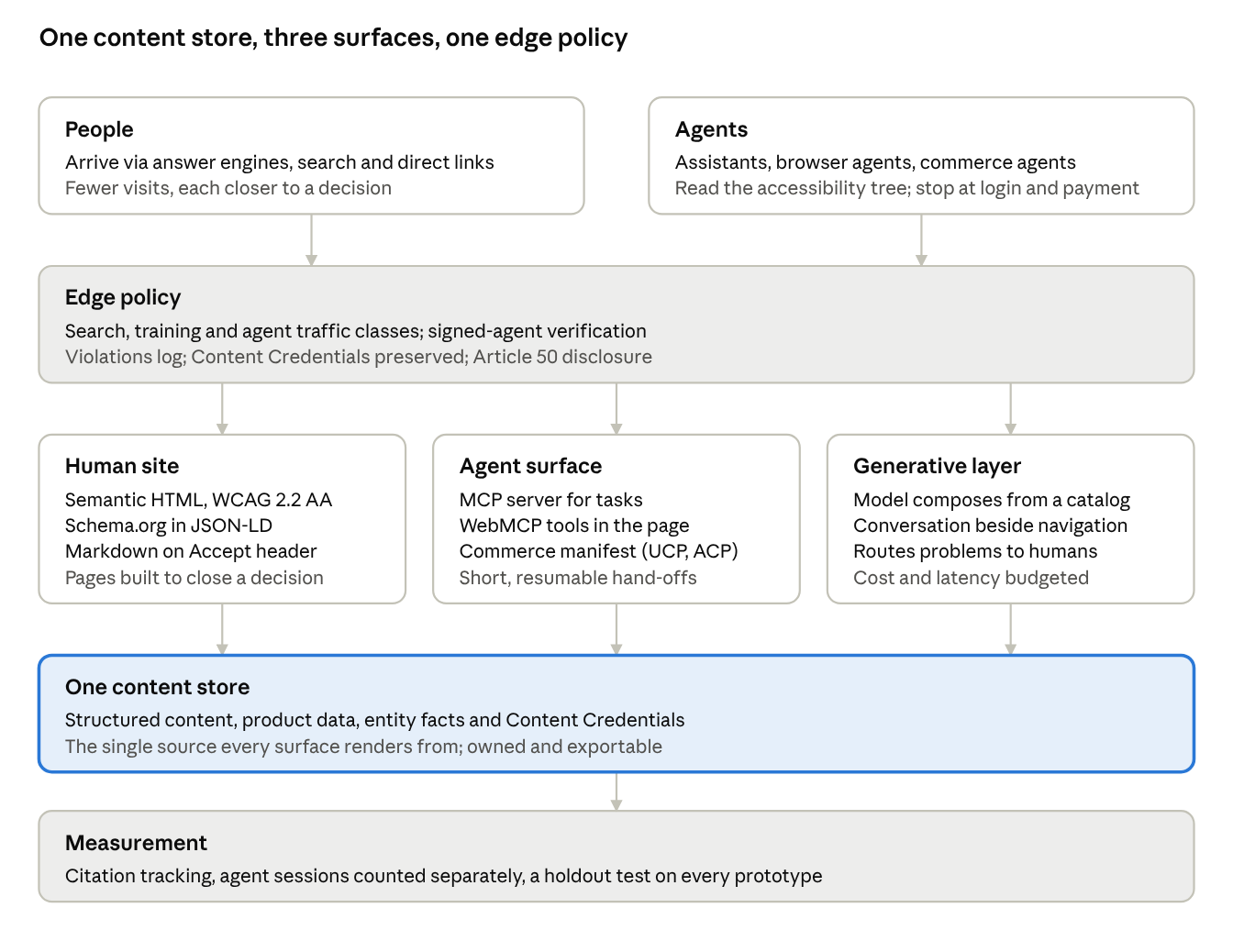
Reference architecture: one content store, three surfaces, one edge policy
Reference architecture: one content store, three surfaces, one edge policy. Figure from the study.

Findings

Five shifts, measurable today

The study’s argument in five parts. Each one has its own section with the evidence, the implications and what it means for Sysbot.

  1. 01

    Discovery moves from search results to answer engines

    AI Overviews reach over 2.5 billion people a month and most Google searches now end without a click to an outside site. Assistants send little traffic back, but the visits they send convert better. Being cited matters alongside being ranked.

    Shift 1: Discovery moves from search results to answer engines
  2. 02

    Agents become visitors

    More than half of web traffic is non-human by the large network measurements, and user-directed agent requests grew seventeenfold in a year. MCP, WebMCP, signed requests and commerce manifests are emerging as the protocols agents act through.

    Shift 2: Agents become visitors
  3. 03

    Interfaces become generative, inside a fixed catalog

    Production implementations have the model compose from developer-defined components. Free-form page generation remains an experiment. People want chat for comparison and research and a person for problems.

    Shift 3: Interfaces become generative, inside a fixed catalog
  4. 04

    Building a website becomes a prompt

    Prompt-built sites reached hundreds of millions in run rate while simple-site prices collapsed. Value has moved to the data model, integrations, security and operation.

    Shift 4: Building a website becomes a prompt
  5. 05

    Trust, provenance and the rules arrive before the standards

    Crawler control is still voluntary, bot identity is a draft already enforced at the edge, and AI transparency and accessibility duties carry binding deadlines. Accessible, semantic interfaces serve the law and the agents alike.

    Shift 5: Trust, provenance and the rules arrive before the standards
  6. What the study does not claim

    Vendor figures for resolution rates, personalisation lift and agent task success are reported as claims, not findings. Whether AI referrals will replace lost search clicks, whether agentic checkout reaches volume, and whether AI companies honour licensing signals are open questions, listed with the bets Sysbot can place on them.

Evidence register

Every sourced claim, graded and re-checked

A companion register lists each sourced claim in the five Shift sections, grades the evidence behind it from E1 (official standard or primary research) to E4 (secondary reporting), records whether the source still states it, and keeps the study’s own interpretations apart as E5.

146
Sourced claims
from 139 distinct sources
104
Confirmed as stated
of 143 v1.0 claims re-checked
24
Confirmed with a caveat
each caveat recorded in the row
50
On E1 or E2 sources
33 official or primary, 17 independent measurement
96
On E3 or E4 sources
48 vendor-reported, 48 secondary
12
Interpretations (E5)
each with what would falsify it

The register is a page, a JSON file and a CSV, so a reviewer, a journalist or an AI assistant can check any figure against its source without trusting the study’s prose. Last checked 31 October 2026.

Technical prototypes

Five prototypes, each with a gate

The study ends in a roadmap of prototypes, each testing one shift with a pre-registered success criterion. They are built on a reference site for a fictional business so the measurements are reproducible.

  1. Prototype 1Measured

    Dual-audience reference site

    Hypothesis. One content store can serve people, search engines and agents through HTML, JSON-LD and Markdown without a separate backend for agents.

    Result. A real browser agent completed 98% of 150 task executions on the reference site with no incorrect action.

    Gate passed · 30 October 2026

  2. Prototype 2In progress

    Agent and citation analytics

    Hypothesis. An operator can tell search, training and agent traffic apart, attribute leads, and measure whether assistants cite the site.

    Result. Signed-agent verification (Web Bot Auth) and an operator dashboard built; a weekly citation probe asks five assistants about the site unattended for four weeks.

    Dashboard gate met · probe runs to 23 November 2026

    Prototype 2: Agent and citation analytics
  3. Prototype 3Measured

    Agent gateway

    Hypothesis. Agents using tools complete tasks at least as well as through the HTML path, with hand-off to a person in one screen and no authorisation bypass.

    Result. 300 executions: 100% completion on browser, REST and MCP; 20 of 20 hand-offs in one screen; 20 of 20 policy checks held.

    Gate met · 31 October 2026

    Prototype 3: Agent gateway
  4. Prototype 4Measured

    Catalog-constrained generative UI

    Hypothesis. A conversational layer composing from a small approved catalog improves task completion over navigation without hurting trust.

    Result. Cost, latency and fallback criteria met (median turn 2.9 s, median $0.007 per session, 0 incorrect actions). Completion was level with navigation, 100% on both arms, so the improvement criterion is reported as not met on a three-product site.

    Measured · 31 October 2026

    Prototype 4: Catalog-constrained generative UI
  5. Prototype 5In progress

    Citation-shaped content

    Hypothesis. Front-loaded, dated, statistic-rich pages earn more assistant citations than the same facts written conventionally.

    Result. Ten matched content pairs published on a public host with a seeded assignment; the weekly probe scores shaped against plain with an exact test after four runs.

    Running · judged 23 November 2026

    Prototype 5: Citation-shaped content
  6. Blueprint

    Technical reference architecture v1.0

    Sysbot’s technical reference architecture for AI-era websites: one content store, a human site, an agent surface, a catalog-constrained generative layer and an edge policy, with the security model, request flows, measurement framework and platform contracts.

    Draft for engineering review

    Technical reference architecture v1.0

Measured

Numbers, with what they do not cover

We publish a measurement when we have one and say what it leaves out. There are no testimonials or customer figures here because we don’t have ones we can stand behind yet.

98%
Task completion by a real browser agent on the reference site
150 executions, no incorrect action. Prototype 1, 30 October 2026.
100%
Completion through the agent gateway on browser, REST and MCP
300 executions, 20/20 policy checks. Prototype 3, 31 October 2026.
90.4%
Recall@5 of the document-review retrieval stage
12-item checklist, 60 public contracts (CUAD). Internal, one pipeline stage, 5 November 2026.
146
Sourced claims graded and re-checked in the evidence register
139 sources; 33 E1, 17 E2, 48 E3, 48 E4; 12 interpretations listed as E5.

Methodology and limitations

How the research is done

  • Desk research over primary sources dated 2025 to October 2026: platform announcements, standards drafts, measured traffic studies and regulatory texts.
  • Every figure links inline to the page it was taken from; every sourced claim is graded E1 to E5 and re-checked against its source in the companion evidence register.
  • Three kinds of statement are kept apart: observed evidence, research interpretation, and strategic hypothesis.
  • Vendor figures for resolution rates, personalisation lift and agent task success are reported as claims, not findings; where sources disagree the disagreement is recorded as an open question.
  • Two independent critical audits were run against the draft and their corrections applied; a third, credibility audit led to version 1.1 and the evidence register.
Full methodology and limitations

Publications

Everything published, in one list

Research in practice

Working on the same questions?

We build and measure what the study describes. Write if you would like to compare notes, put it to work, or publish together.